
Trademark
Disclaimer
This article may contain attorney advertising material. Contents on this website are for general information only. It is not legal advice, and reading it does not create an attorney-client relationship with Kaelus Law, PLLC. Trademark law depends on your specific facts. Please speak with a licensed attorney before acting on anything in this article.

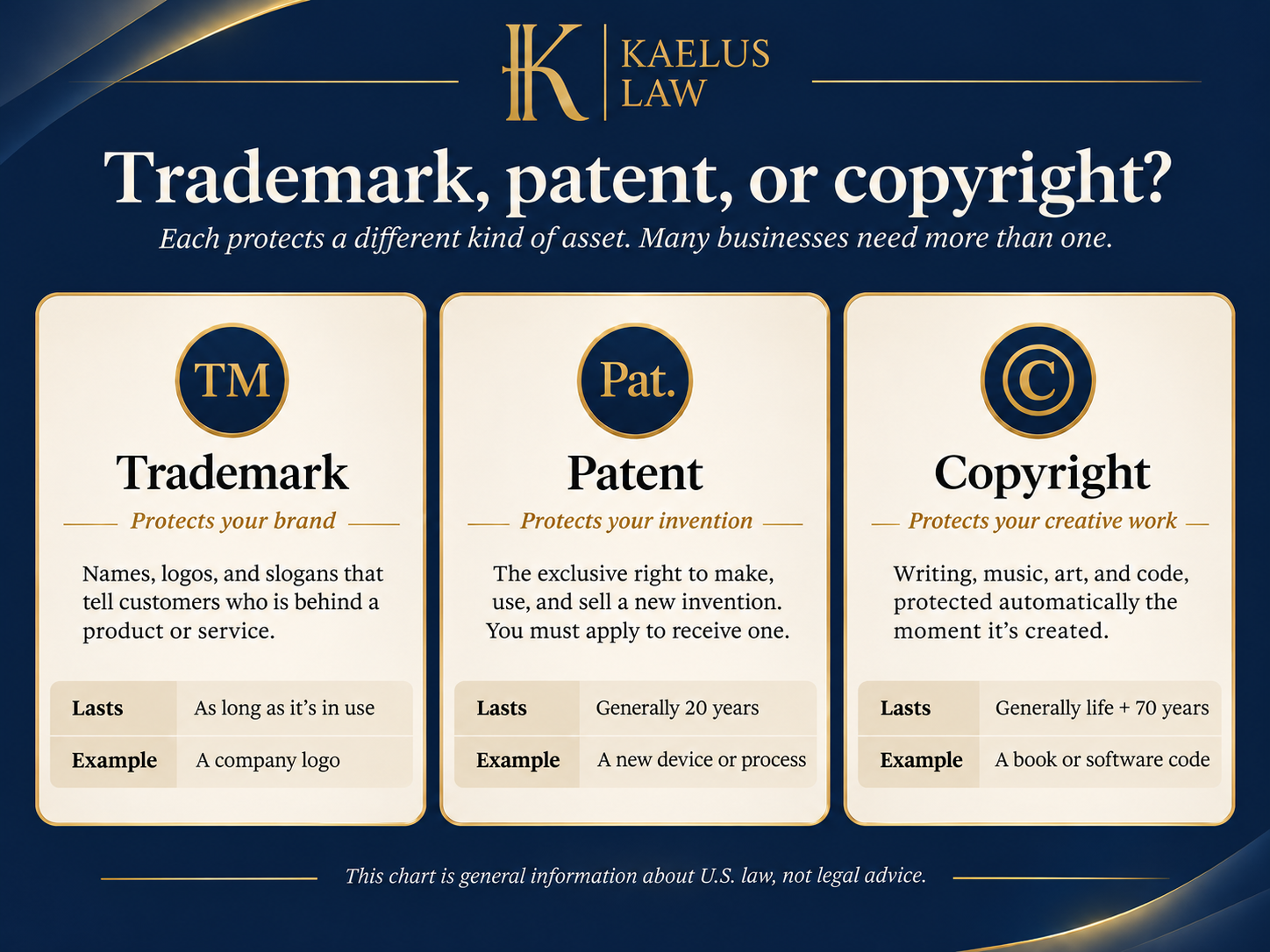
Trademark vs. Copyright vs. Patent
Trademark vs. Copyright vs. Patent at a Glance
Trademark
Copyright
What it protects?
Example
Where to register?
How long it lasts?
When right starts
Words, names, logos, slogans, and other signs that identify the source of goods or services.
A company name or logo
U.S. Patent and Trademark Office (USPTO)
As long as the mark is used and maintenance filings are made
Use in commerce creates limited rights; federal registration adds nationwide benefits
Original creative works, such as writing, music, photos, art, and software code.
A blog post, song, or website copy
U.S. Copyright Office
Generally the author’s life plus 70 years
When the work is created and fixedd in a tangible form
Patent
New and useful inventions, processes, machines, and designs.
A new device or manufacturing method
U.S. Patent and Trademark Office (USPTO)
Generally 20 years from filing (utility); 15 years from grant (design)
Only when the patent is granted
Do I need to register my trademark?
No, but registration helps. Using a mark in business can create common law rights, but those rights are generally limited to the geographic area where you use the mark (USPTO, Why register your trademark?). A state registration generally protects you only in that state. A federal registration with the USPTO offers broader benefits, including:
Nationwide notice. Registration on the Principal Register gives constructive notice of your ownership claim across the country (15 U.S.C. § 1072).
Legal presumptions. The registration certificate is evidence that the mark is valid and that you own it and have the exclusive right to use it for the listed goods or services (15 U.S.C. § 1057(b)).
Nationwide priority. Once registered, your filing date generally counts as a nationwide date of first use (15 U.S.C. § 1057(c)).
Federal court and remedies. You can bring claims in federal court and may be able to seek damages, profits, and costs (15 U.S.C. §§ 1121, 1117).
Customs protection. You can record the registration with U.S. Customs and Border Protection to help block infringing imports (15 U.S.C. § 1124).
The ® symbol. Only federally registered marks may use ® (15 U.S.C. § 1111).
What is the difference between ™ and ®?
Anyone may use ™ (or ℠ for services) to signal that they claim rights in a mark. No registration is required. The ® symbol is different: it may be used only after the USPTO registers the mark, and only for the goods or services listed in the registration. Using ® on an unregistered mark can cause legal problems, so wait until your registration issues.
Can any name be registered?
No. The USPTO may refuse a mark that is likely to be confused with an existing registered mark, or that merely describes the goods or services (15 U.S.C. § 1052(d), (e)). For example, "Best Plumbing" for plumbing services would likely face a descriptiveness refusal. Distinctive or made-up names are usually easier to protect. This is why a search before filing is worth doing.
How does the federal registration process work?
Search. Check the USPTO database and the market for similar marks used for related goods or services.
Choose the filing basis. File based on current use in commerce, or on a good-faith intent to use the mark in the future (15 U.S.C. § 1051(a), (b)).
Identify goods, services, and classes. Each application must describe exactly what the mark is used for, sorted into one or more international classes. One application can cover several classes, with a fee for each class (37 C.F.R. § 2.86).
File the application. The owner of the mark, or someone authorized to sign for the owner, verifies the application under oath (37 C.F.R. § 2.33).
Examination. A USPTO examining attorney reviews the application and may issue an Office action that requires a response.
Publication. If approved, the mark is published so third parties can oppose it.
Registration. If no opposition succeeds, the mark registers. For intent-to-use applications, the owner must first file proof of use before registration (15 U.S.C. § 1051(d)).
How long does it take?
Timelines vary, and the USPTO controls them. For fiscal year 2026, the USPTO reported an average of 4.1 months to a first action on an application, and an average of 9.5 months to final disposal (USPTO, October 2026). Applications that receive objections, face an opposition, or rely on intent to use typically take longer. Any timeline is an estimate, not a guarantee.
How long does a Trademark registration last?
A federal registration can last indefinitely as long as the mark stays in use and the owner makes required filings. The owner must file a declaration of use between the fifth and sixth year after registration, and must renew every 10 years (15 U.S.C. §§ 1058, 1059). Missing these deadlines can cancel the registration.
Commonly Asked Questions
About Kaelus’ Trademark Filing
What do you need from me to get started?
Before we can take on a new matter, we run a conflict check. Please send the trademark owner's full legal name and address and the mark you want to protect. If the owner is a company, also include the full legal names of its owners or principals and the state where the company was formed. Please do not send logo files or detailed business information until we confirm that we can take the matter.
How quickly will you respond?
We aim to respond to new trademark inquiries within two business day.
What happens if you cannot take my matter?
We will let you know promptly. We do not share the reasons for a conflict. No fee is owed, because payment is not collected until you sign an engagement letter.
What will I need to sign?
Before we begin, you will sign our engagement letter and a power of attorney that authorizes us to file with the USPTO on your behalf. Before we file, you will review the final application and electronically sign the USPTO declaration. Our practice is to have the owner, or a person with authority to sign for the owner's company, sign that declaration personally (37 C.F.R. §§ 2.33, 2.193(e)(1)).
How should I describe my products or services?
In your own plain words. Tell us what you sell now and what you plan to sell. We will determine the correct class, the filing basis, and the formal description used in the application.
What files will I need to provide?
Logo: a JPG file, if you are filing a logo or design mark.
Specimens: if your mark is already in use, one example for each class showing the mark as customers see it, such as a photo of the product or label, or a screenshot of a web page where customers can buy (37 C.F.R. § 2.56).
Foreign registration: only if you are claiming rights based on a foreign application or registration.
Will I speak with an attorney?
Yes. Every filing includes at least one call between you and a Kaelus Law attorney. On that call, we confirm the facts, discuss the mark, and walk through the filing process. If someone helps you gather information, they are welcome to join for introductions, but the legal discussion is between you and your attorney.
What is the difference between a knockout search and a comprehensive clearance search?
A knockout search is a preliminary screen for obvious conflicts in the USPTO database. A comprehensive clearance search also reviews state and common law sources, and includes an attorney's written opinion on conflict risk and filing strategy. No search or opinion can guarantee registration.
Can I protect my name and my logo in one application?
No. A name in plain text (a "standard character" mark) and a logo or design are separate marks and require separate applications. A standard character registration protects the words themselves, regardless of font, style, or color (37 C.F.R. § 2.52(a)). We can help you decide which to file first.
Can one application cover more than one class?
Yes, when it makes sense for your business. The USPTO charges a fee for each class, and you will need a description and, if the mark is in use, a specimen for each class (37 C.F.R. § 2.86).
What costs could come up after I file?
Some costs depend on how the application proceeds. Examples include USPTO surcharges (for instance, for a custom description of goods or services), responses to Office actions, extensions of time, and the filing that proves use for intent-to-use applications (USPTO fee schedule). Government fees are passed through at cost. We will contact you before incurring costs outside your original quote.
How soon will you file?
For our filing packages, we aim to file within three business days after we receive your signed engagement letter, your signed power of attorney, payment, and a complete intake form. For packages that include a written clearance opinion, the opinion typically takes 5 to 7 business days, and we file within three business days after you approve it.
Do you guarantee my trademark will be registered?
No. The USPTO decides whether to register a mark, and third parties may oppose it. We can assess risk and give you our professional judgment, but no attorney can guarantee a result.